Module 3: Equipment, Inspection & Maintenance
Rider Bands in Reciprocating Compressors
Refineries operate continuously.
That simple, 3-word sentence, has a lot of implications for refinery maintenance.
Mechanical equipment, such as pumps and compressors, cannot operate continuously forever. To maximize the duration that a refinery can run continuously, it makes sense to group maintenance activities together.
Refinery start-ups and shutdowns can take multiple days, thus avoiding several small outages is beneficial.
For further optimization, the duration of these maintenance activities should be minimized. This is a basic explanation of why "Turnarounds" exist.
In a Turnaround, a refinery, or a section of a refinery, is shutdown to perform maintenance and inspections that cannot be completed during normal operations.
To help plan for Turnarounds, equipment maintenance plans are scheduled years in advance.
Moreover, remaining years of life of run-time are estimated for large equipment such as compressors.
One component of reciprocating compressors that can be a point-of-failure are "Rider Bands".
What Rider Bands Do
The purpose of rider bands is to prevent metal-to-metal contact of the piston against the cylinder wall.
Rider bands are designed as a consumable component, which means they wear down over time and eventually will need to be replaced.
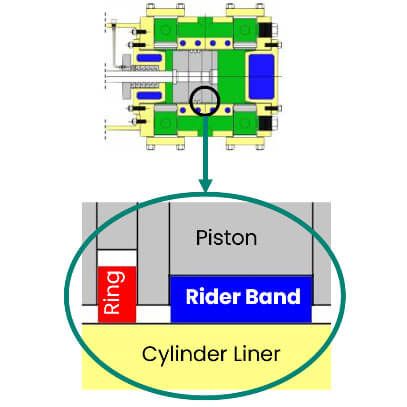
Materials and Piston Rings
Rider band material is typically PEEK or PTFE (plastics or composites). Historically, they were made from soft metals such as babbitt.
Rider bands are often discussed with piston rings. Piston rings provide a seal between the piston and the bore, while rider bands are designed to carry the full weight of the piston.
Wear Rate
Wear rate can be very low, especially in a lubricated cylinder application. Wear rate can be higher with improper lubrication, moisture in the process gas, or excessive particulates in the process gas.
Monitoring
Online monitoring of rider band wear is possible, but how extensively it is used is unclear. Two methods are Rod Drop and the newer Rod Position Pair methodology (Bently Nevada).
Works Cited
[1] Baker Hughes Bently Nevada - Reciprocating Compressor Condition Monitoring