Module 2: Refinery Processes & Units
How Reforming Raises Naphtha Octane
Reforming converts full-range naphtha (C6 to C11) into a high-octane gasoline blending component called reformate. It is one of the most important upgrading processes in a refinery.
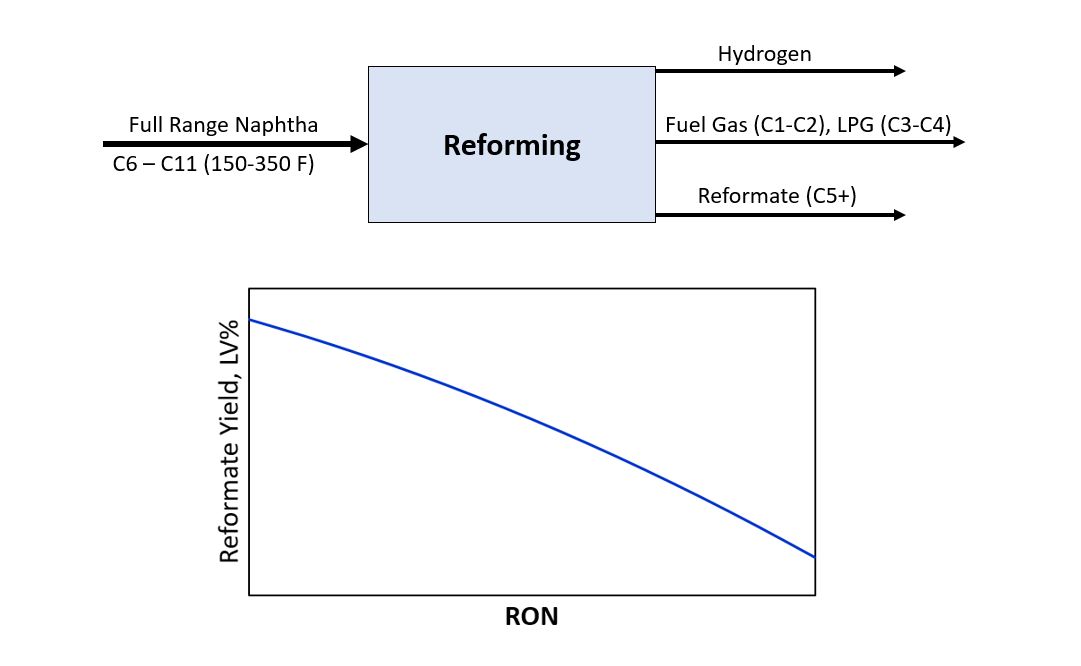
Products of Reforming
The primary product is reformate, but the unit also produces hydrogen, fuel gas (mostly C1 and C2), and LPG (mostly C3 and C4). Fuel gas and LPG are much lower in value than reformate, so operators aim to maximize liquid yield. Some refineries rely on their reformer as the primary source of hydrogen for other processes such as hydrotreating and isomerization.
Severity and the Octane Tradeoff
Operators adjust the severity of the reformer to target a specific octane rating, measured as Research Octane Number (RON), based on gasoline blending needs. The tradeoff is that higher severity reduces liquid volume yield of reformate for two reasons: more feed is converted to fuel gas and LPG, and the density of high-octane reformate increases due to higher aromatic content.
CCR Platforming
The dominant reforming technology is the CCR Platformer, which stands for Continuous Catalyst Recirculation, licensed by UOP. As of 2015, more than 250 CCR platforming units were in operation worldwide, with an average unit capacity of around 23,000 barrels per day. [1]
References
[1] Handbook of Petroleum Refining Processes, 4th Ed., Meyers