Module 2: Refinery Processes & Units
The Anatomy of a Refinery Process Unit
If a refinery is compared to the human body, then process units are the organs. Each one has a purpose, with inputs and outputs, and most involve chemical reactions.
A process unit is a group of interconnected equipment, pumps, vessels, heat exchangers, that share a common purpose. That purpose is typically to rearrange molecules, separate them, or both.
The Block Flow Diagram
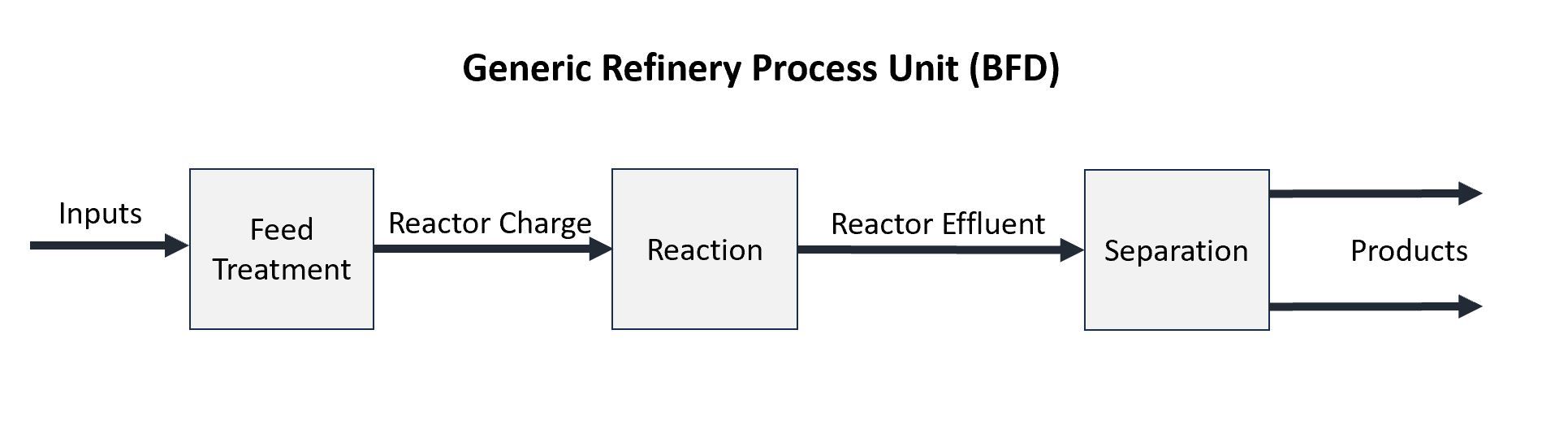
The diagram below is called a block flow diagram, or BFD. It is used throughout the chemical process industries to give a high-level overview of a process. Most refinery process units follow the same three-section pattern: feed treatment, reaction, and separation.
Feed Treatment
Also called feed preparation. Some process units require impurities to be removed from the feed before it enters the reactor. This protects the catalyst and prevents corrosion. Common impurities that must be removed include sulfur and water.
Reaction
Inside the reactor, molecules are rearranged. There is a desired product and potentially undesired byproducts. Engineers design the process to maximize the desired product and monitor it continuously during operation.
Separation
The stream leaving the reactor is called the reactor effluent, or just "effluent". It contains a mix of products that must be separated and purified. Each separated product has a target purity spec and an acceptable limit for contaminants.