Module 1: Hydrocarbon Chemistry, Feedstocks & Products
Paraffin: A Refinery Vocab Essential
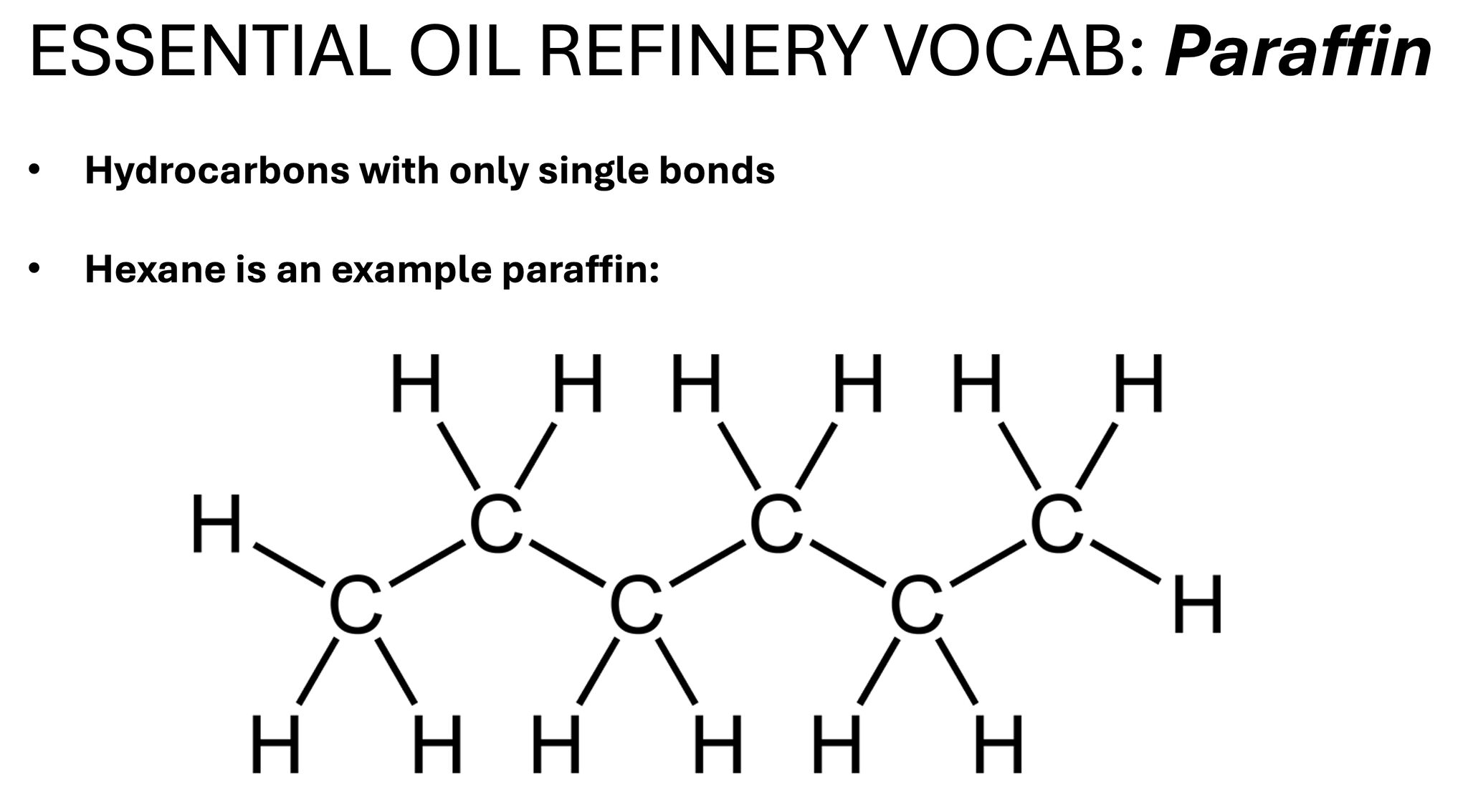
Within the context of refining, paraffin describes a type of hydrocarbon that is composed of only carbon-to-carbon single bonds and carbon-to-hydrogen bonds.
This type of hydrocarbon is better known in chemistry as an "alkane". However, you will rarely hear the word "alkane" when classifying crude oils or refinery intermediate streams.
On the Wikipedia page for "Alkane", the word paraffin is described accurately as "a historical trivial name that also has other meanings" [1]. It may be trivial, but that does not stop the refining industry from using it!
Examples in Context
📍 For example, a crude oil may be classified as "paraffinic". This means that the crude oil contains a high percentage of alkanes.
📍 Let's do a second example. This is from a textbook describing a refinery process to remove benzene from gasoline: "Paraffinic hydrocarbons are not reactive and, therefore, have no impact on the process except for their impact on the vapor pressure of the reaction mixtures" [2]
Context Matters
Context is important because paraffin is used in some countries as another name for kerosene, which is jet fuel.
Paraffin Wax
Also, "paraffin wax" is a hydrocarbon, but is typically white and solid at room temperature. The molecules that compose paraffin wax are mostly alkanes, but they are large (20 to 40 Carbon atoms). So for paraffin wax, smaller alkanes are excluded.
References
[2] Handbook of Petroleum Refining Processes Chapter 1.3