Module 1: Hydrocarbon Chemistry, Feedstocks & Products
Ethanol, Blendstock, and the Last Mile of Gasoline
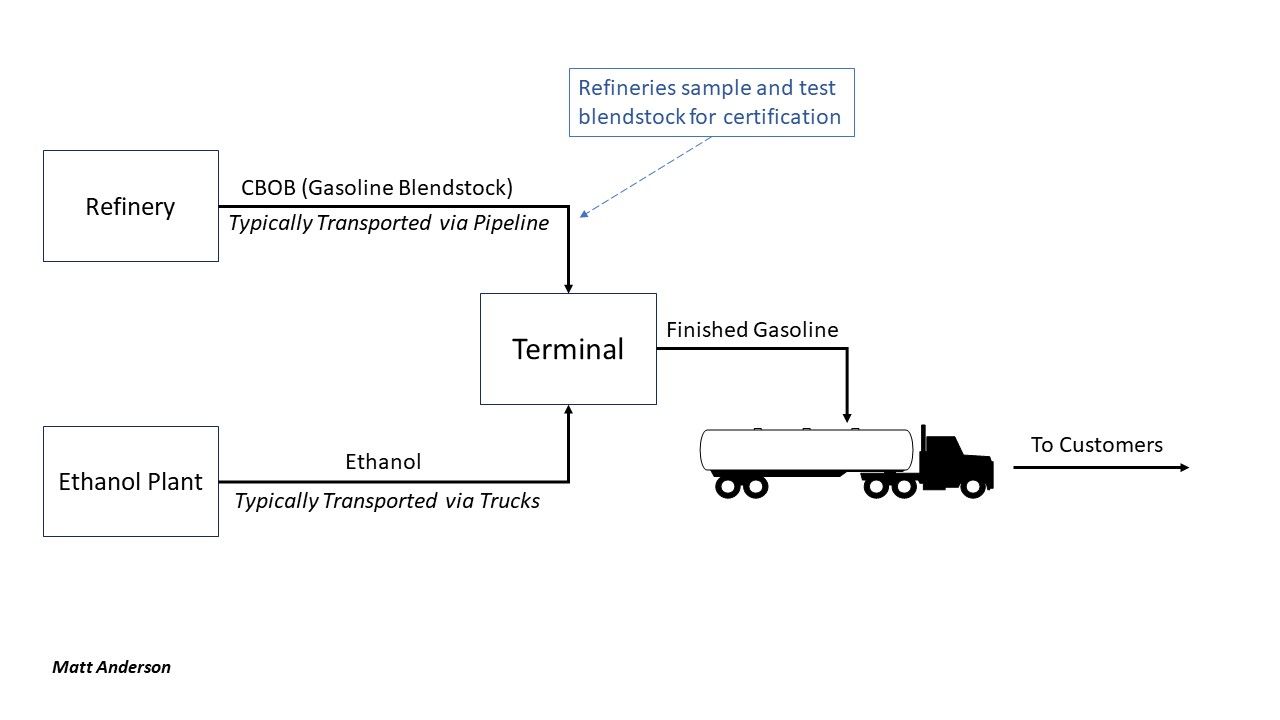
Refineries don't produce gasoline. They produce gasoline components that are mixed to make blendstock. Ethanol is added to the blendstock to make finished gasoline.
What Is Blendstock?
The most common gasoline blendstock in the United States is CBOB, Conventional Blendstock for Oxygenate Blending. "Oxygenate" is the name of a family of chemicals that includes ethanol.
Ethanol is mixed with blendstock at terminals prior to loading trucks. Ethanol, and gasoline that contains ethanol, is rarely transported by pipeline because of its affinity for water. According to the Department of Agriculture, 90% of ethanol is transported by train or truck, and 10% by barge, with minimal amounts moved by pipeline.
Why Blendstock Travels by Pipeline
Because ethanol must be added at the terminal rather than at the refinery, refineries transport blendstock by pipeline before ethanol blending occurs. Pipeline transportation is far more economical than trucks for large volumes, so the economics strongly favor keeping ethanol out of the pipeline system.
How Gasoline Gets Certified
Gasoline must meet specifications to be certified and sold. This raises an obvious question: does each truck need to be sampled after blendstock and ethanol are mixed at the required composition? Fortunately, no.
The typical process is for the refinery to certify a large batch of blendstock. The refinery or a third-party lab takes samples and adds ethanol prior to completing the certification tests. This simulates the blending that will happen at the terminal, allowing the entire batch to be certified upfront rather than truck by truck.
Specs Vary by State and Season
The exact specifications and test methods vary by both state and season. One common adjustment: gasoline specs require lower vapor pressure in the summer than in the winter.
Octane and the Ethanol Effect
Ethanol has an octane number of 100, but when blended with gasoline it effectively boosts octane beyond what its rating alone would suggest. Because of this, the blendstock octane target is set lower, so that after ethanol is added at the terminal, the finished gasoline octane meets specification.